



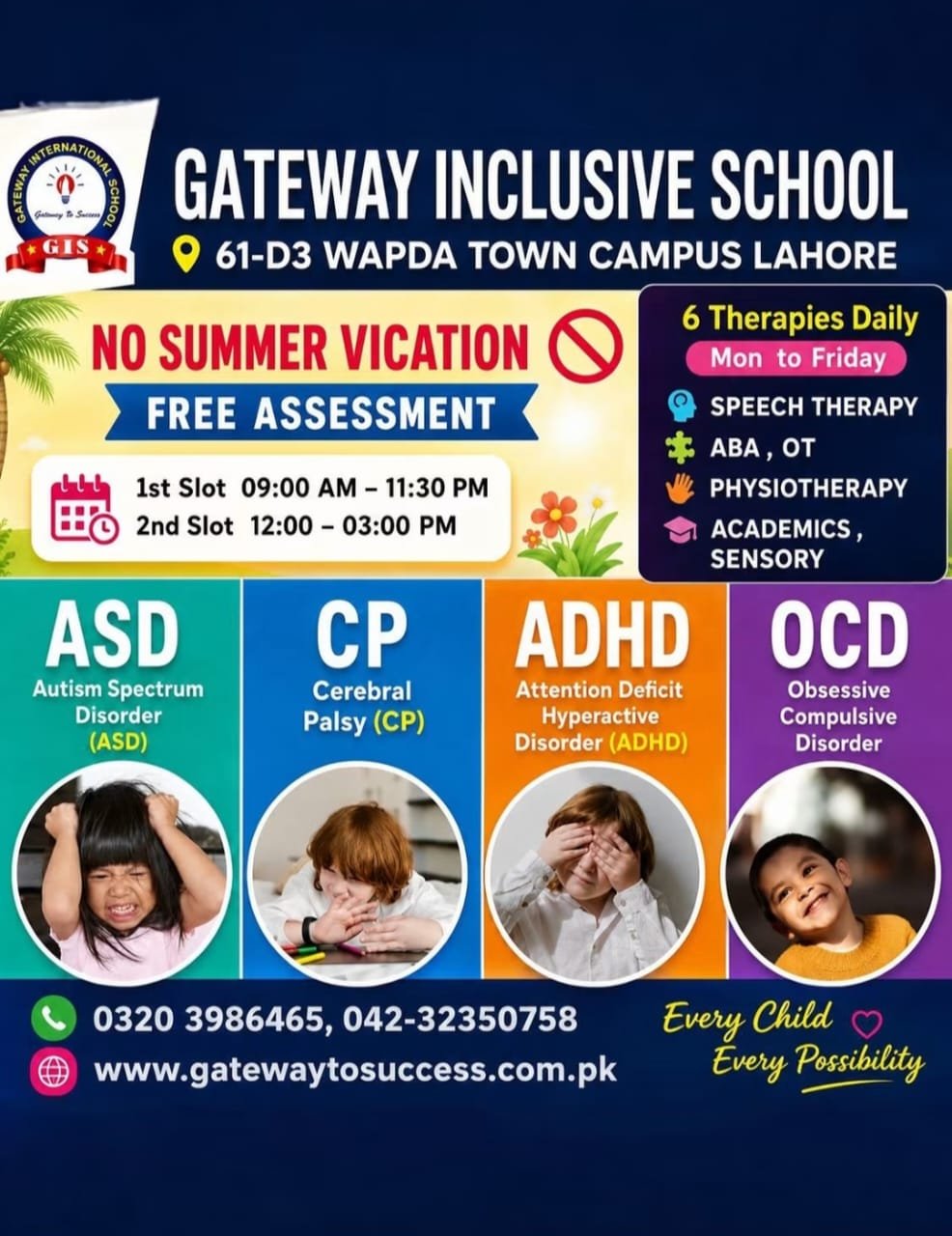
OCD Support for Children begins with understanding symptoms, responding with compassion, and seeking professional guidance alongside appropriate educational support at Gateway Inclusive School Lahore.
Understanding OCD Support for Children
Children may sometimes repeat an action, ask the same question several times, or feel uncomfortable when their routine changes. However, when unwanted thoughts and repetitive behaviours become persistent, distressing, or disruptive to daily life, parents may need to seek professional advice.
Obsessive-Compulsive Disorder (OCD) is a mental health condition involving obsessions, compulsions, or both. Obsessions are unwanted, intrusive thoughts, images, or urges that cause distress. Compulsions are repetitive behaviours or mental acts that a person feels driven to perform, often to reduce anxiety or respond to a feared situation.
OCD Support for Children begins with understanding these experiences without blame or judgement. At Gateway Inclusive School Lahore, an inclusive educational approach can help promote respect for individual needs, while concerns about OCD require appropriate assessment by a qualified mental health professional.
Why OCD Support for Children Matters
OCD can affect a child’s emotional well-being, concentration, schoolwork, relationships, and everyday routines. A child may spend considerable time checking something repeatedly, seeking reassurance, counting, or trying to make things feel exactly right.
These behaviours are not necessarily deliberate misbehaviour. A child may feel worried or overwhelmed and struggle to explain what is happening.
OCD Support for Children matters because early recognition and appropriate professional guidance can reduce unnecessary distress and help families understand how to respond. Parents and teachers should avoid shaming children, dismissing their fears, or assuming that repetitive behaviour is simply attention-seeking.
It is also important to remember that liking cleanliness, preferring an organised desk, or repeating an activity occasionally does not automatically indicate OCD. Diagnosis requires a careful professional assessment.
Recognising Signs That May Require OCD Support for Children
Possible signs include repeated checking, excessive reassurance-seeking, distressing intrusive thoughts, repetitive washing, or a strong need to repeat certain actions according to rigid rules. Some compulsions are less visible and may involve silently counting, repeating words mentally, or trying to neutralise unwanted thoughts.
Not every child experiences the same symptoms, and repetitive behaviour can have other explanations. Parents should consider whether the behaviour causes significant distress, takes up considerable time, or interferes with learning, sleep, friendships, or family routines.
OCD Support for Children should never rely on assumptions based on a photograph, a single behaviour, or a classroom observation. If concerns persist, parents should consult a qualified child mental health professional for assessment and guidance.
OCD Support for Children Through Family and School Collaboration
Families and schools can work together to create a respectful and predictable learning environment. Teachers may help by communicating calmly, explaining classroom expectations clearly, and discussing any learning difficulties with parents through appropriate channels.
A child experiencing OCD may need understanding when distress affects participation or concentration. However, support should not involve automatically accommodating every compulsion, as repeated reassurance or participation in rituals can sometimes maintain the OCD cycle.
Parents and teachers should follow guidance from the child’s treating professional when deciding how to respond to symptoms. Consistent communication can help adults support the child without embarrassment, punishment, or unrealistic expectations.
How Gateway Inclusive School Lahore Can Contribute to OCD Support for Children
Gateway Inclusive School Lahore displays educational and therapy programmes that include academics, Applied Behaviour Analysis (ABA), Occupational Therapy (OT), speech therapy, physiotherapy, and sensory activities. These programmes serve different purposes and should not be presented as interchangeable treatments for OCD.
For a child experiencing OCD, the school’s educational role may include understanding individual learning needs, communicating with the family, and considering appropriate classroom adjustments where necessary. Any additional support should be based on the child’s assessment, the school’s actual provision, and recommendations from qualified professionals.
OCD Support for Children requires particular care because educational support alone does not replace mental health treatment. Families should discuss available school support directly with Gateway and consult a qualified professional about suitable treatment.
Professional Guidance for Effective OCD Support for Children
Evidence-based treatment can make a meaningful difference for children with OCD. Cognitive Behavioural Therapy (CBT), particularly Exposure and Response Prevention (ERP), is an established treatment approach. It involves learning to face anxiety-provoking situations gradually and safely while reducing compulsive responses, under the guidance of a trained professional.
Some children may also benefit from medication prescribed and monitored by an appropriately qualified medical professional. Treatment decisions depend on symptom severity, age, individual circumstances, and professional assessment.
Parents should not attempt to force a child to confront fears or abruptly prevent compulsions without suitable guidance. A qualified clinician can help families understand the treatment plan and support the child safely.
Building a Compassionate Path Forward
OCD can be distressing, but children should never be defined by their symptoms. Patient communication, professional guidance, and appropriate educational support can help them feel understood while working towards their individual goals.
Gateway Inclusive School Lahore can contribute by promoting an inclusive learning environment and communicating with families about educational needs. With the right professional care and a supportive network, children can be helped to participate more comfortably in everyday life.
Inclusive Education at Gateway International School Lahore
Come Visit Us Today! 🌟💖 Meet our dedicated staff and supportive management.
Contact Us: 0323-4197845, 042-32350758
Follow Us on Social Media: Click here to join our Facebook page, Follow us on Instagram Or Here to read our Blog