



Multisensory Learning Activities at Gateway International School Lahore support children in both mainstream and inclusive streams through colour and shape recognition, communication, attention, and cognitive development.
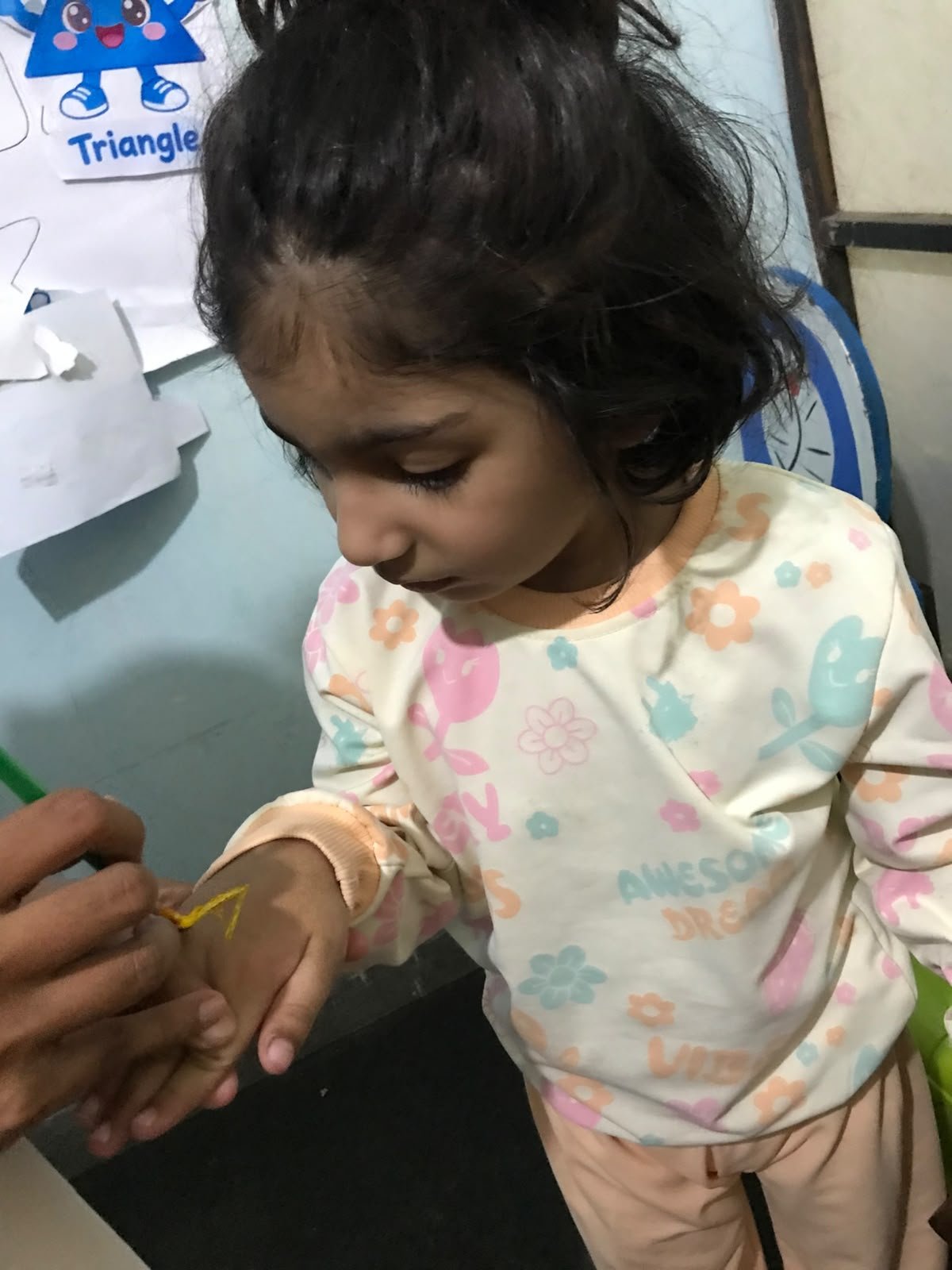
Children learn more effectively when they can see, hear, touch, observe, and interact with the world around them. At Gateway International School Lahore, Multisensory Learning Activities are an important part of creating engaging and meaningful learning experiences for children in both the mainstream stream and the Inclusive Branch.
These techniques are not limited to children with additional learning needs. Children in mainstream classrooms also benefit from structured activities that develop communication, recognition, attention, problem-solving, and cognitive abilities. Similarly, children in the Inclusive Branch are provided with appropriately adapted activities, individual attention, and additional support according to their learning needs.
Teachers use a combination of visual materials, verbal instructions, modelling, repetition, positive reinforcement, and hands-on experiences to make concepts easier to understand. Some activities may also incorporate ABA-informed teaching strategies, particularly when structured prompting and reinforcement can support a child’s learning.
Here are seven important ways these activities contribute to children’s overall development across both streams at Gateway International School Lahore.
1. Multisensory Learning Activities Using ABA-Informed Teaching Strategies
Structured teaching strategies help children understand what is expected of them and how to respond. Techniques such as modelling, prompting, repetition, breaking tasks into smaller steps, and positive reinforcement can make learning more organised and accessible.
For example, a teacher may show a child a coloured object, name its colour, and encourage the child to identify it. If the child needs assistance, the teacher can provide a verbal or visual prompt and gradually reduce that support as the child becomes more independent.
At Gateway International School Lahore, structured strategies can be used in both mainstream and inclusive classrooms. In mainstream classes, they can reinforce concepts and encourage active participation. In the Inclusive Branch, teachers can adapt the level of prompting, repetition, and individual support according to each child’s abilities and learning goals.
The purpose is to help every child participate meaningfully and develop greater independence.
2. Multisensory Learning Activities for Colour Recognition
Colour recognition is an important early learning skill. It helps children notice similarities and differences, understand visual information, and develop vocabulary.
Teachers can introduce different colours through flashcards, coloured objects, blocks, toys, and everyday classroom materials. Children may be asked to identify a particular colour, point towards it, select it from a group, or name it verbally.
For instance, a teacher may present red, blue, and yellow objects and ask children to find the red one. Repeated practice with different materials helps children recognise that a colour remains the same even when the object changes.
In mainstream classrooms, these activities reinforce early concepts and encourage observation and independent responses. In the Inclusive Branch, teachers can adjust the number of choices, use additional visual prompts, and provide repeated practice where needed.
These activities support visual attention, colour identification, listening, and early language development.
3. Multisensory Learning Activities for Shape Recognition
Recognising shapes helps children understand basic visual concepts and notice the features of objects. Circles, squares, triangles, and rectangles can be introduced through cards, puzzles, blocks, and real-life objects.
A teacher may show a circle, say its name, and invite children to select another circle from a collection of different shapes. Children can also match identical shapes or identify shapes in their surroundings.
In the mainstream stream, shape-based activities can strengthen concept recognition, comparison, and early problem-solving. In the Inclusive Branch, teachers can use simplified choices, hands-on materials, demonstrations, and individual guidance to make the same concepts accessible.
Such activities encourage observation, visual discrimination, matching, and early problem-solving. As children become more familiar with basic shapes, teachers can introduce more challenging tasks according to their developmental level.
4. Multisensory Learning Activities to Develop Verbal Naming and Speech
Verbal naming gives children opportunities to connect objects, colours, and shapes with spoken words. It also encourages pronunciation, vocabulary development, and communication.
During an activity, a teacher may present a coloured object and ask, “What colour is this?” The child may respond by naming the colour, repeating the word, or attempting to produce the sound. Similarly, children can practise naming familiar shapes and objects.
In mainstream classrooms, these interactions help expand vocabulary, improve pronunciation, and develop confidence in speaking. In the Inclusive Branch, teachers can provide additional modelling, repetition, prompting, and response time according to individual communication needs.
Children who are not yet using spoken words consistently can also participate through pointing, picture selection, gestures, or other appropriate communication methods. The objective is not simply to make children repeat words but to encourage meaningful communication.
5. Multisensory Learning Activities for Receptive Language Development
Receptive language refers to understanding words, instructions, questions, and spoken information. It is an essential part of communication because children need to understand what others say before they can respond appropriately.
Simple instructions such as “Show me the blue circle”, “Pick up the red block”, or “Point to the square” provide opportunities to practise listening and comprehension.
In mainstream classrooms, these instructions can reinforce vocabulary, listening skills, and the understanding of concepts. In the Inclusive Branch, teachers may begin with one-step instructions, use visual demonstrations and gestures, and gradually increase complexity as a child develops understanding.
At Gateway International School Lahore, these activities help children practise listening, follow instructions, identify familiar concepts, and respond more appropriately in structured learning situations.
6. Multisensory Learning Activities for Expressive Language and Communication
Expressive language is the ability to communicate thoughts, needs, ideas, and information through words, gestures, signs, or other communication methods.
Colour and shape activities create natural opportunities for children to express themselves. A child may name a colour, request a particular object, answer a question, or describe what they see. Teachers can encourage communication by asking simple questions, modelling useful words, expanding children’s responses, and providing opportunities to make choices.
In mainstream classrooms, these activities encourage conversation, sentence formation, vocabulary development, and confident participation. In the Inclusive Branch, teachers can adapt communication expectations and provide individualised support so that children can express themselves through the communication methods available to them.
These interactions help children use language for meaningful purposes rather than relying only on repetition.
7. Multisensory Learning Activities to Improve Attention, Visual Discrimination and Cognitive Skills
Attention, visual discrimination, matching, categorisation, and problem-solving are important abilities for classroom learning.
Activities involving coloured objects and different shapes can help children focus on a task, observe details, compare visual information, and make choices. For example, a child may be asked to match identical shapes, group objects according to colour, or select an item that is different from the others.
In mainstream classrooms, these tasks can strengthen concentration, logical thinking, memory, and independent problem-solving. In the Inclusive Branch, teachers can adjust the difficulty, reduce distractions, offer additional prompts, and provide individual practice to support each child’s progress.
These activities develop the ability to notice visual differences and similarities. They also encourage memory, concentration, logical thinking, and early categorisation skills.
Teachers can begin with a small number of objects and gradually increase the level of difficulty according to children’s abilities and progress.
Gateway International School Lahore: One Learning Approach, Two Streams, Every Child Matters
At Gateway International School Lahore, multisensory teaching is not restricted to the Inclusive Branch. It is a valuable part of learning in both the mainstream stream and the Inclusive Branch because every child benefits from opportunities to observe, explore, communicate, and participate actively.
The difference lies in how activities are planned and adapted. Mainstream classrooms use these techniques to reinforce concepts, encourage independent thinking, and develop essential academic and communication skills. In the Inclusive Branch, teachers provide additional individual attention, structured support, repetition, and adapted learning experiences according to each child’s needs.
This approach reflects Miss Irum Kharal’s vision of inclusive education: recognising individual potential, creating meaningful learning opportunities, and ensuring that every child receives the support needed to progress.
At Gateway, the aim is not to make every child learn in exactly the same way. It is to provide the right learning opportunities so that every child can move forward with confidence.
At Gateway International School Lahore, every child learns, every effort matters, and every small achievement opens the door to greater possibilities.