

 Water Resources Project at Gateway International School Lahore helps students explore natural water sources, understand their importance, and learn the value of water conservation.
Water Resources Project: Exploring the Sources of Life
Water is one of the most valuable natural resources on Earth. Every living thing depends on water for survival, while human communities need it for drinking, agriculture, sanitation, industry, and many other essential activities. Understanding where water comes from and why it must be protected is an important part of environmental education.
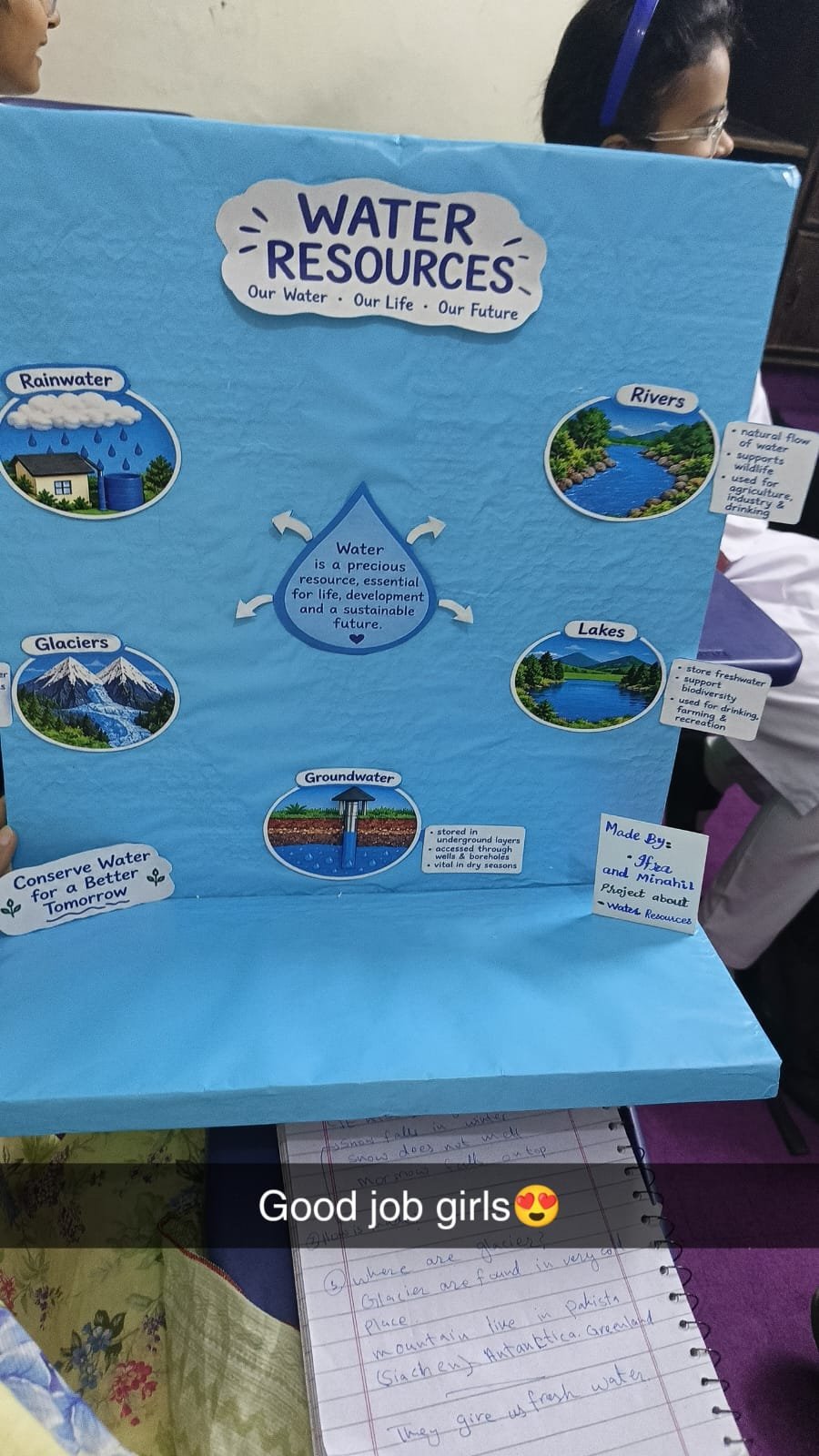
At Gateway International School Lahore, students explored this important subject through a creative Water Resources Project. The display presented different sources of water, including rainwater, rivers, lakes, glaciers, and groundwater. With labelled illustrations and brief explanations, the students showed how these resources contribute to life and support the environment.
The project encouraged students to look beyond the water that comes out of a tap and recognise the natural systems that make water available to people and ecosystems.
Water Resources Project: Understanding Rainwater
Rain is an important part of the natural water cycle and a major source of freshwater. When rain falls, some of it flows into rivers and lakes, while some enters the ground and helps replenish underground water supplies.
The project highlighted rainwater as a valuable resource that can also be collected and stored for suitable uses. Rainwater harvesting is one way communities can make better use of rainfall, particularly in areas where water availability is limited.
Learning about rainwater helps students understand the connection between weather, nature, and the availability of water in their surroundings.
Water Resources Project: Discovering the Importance of Rivers
Rivers are natural flowing bodies of water that support human communities, agriculture, plants, and wildlife. They provide water for irrigation and, where properly treated, for drinking and other domestic needs.
Many communities have developed around rivers because of their importance for food production, transportation, and economic activities. Rivers also provide habitats for different forms of aquatic life.
Through this part of the Water Resources Project, students explored how rivers are connected to everyday life and why keeping them clean is essential for environmental protection.
Water Resources Project: Learning About Glaciers
Glaciers are large masses of ice that form over long periods in cold regions and high mountains. They store a significant amount of the world’s freshwater. As glaciers melt, they release water that contributes to rivers and other water systems.
Glaciers are particularly important in mountainous regions. In Pakistan, glaciers in the northern mountain ranges contribute to river systems that support communities and agriculture.
The students’ display introduced glaciers as another important natural water resource. It also provided an opportunity to understand why changes in temperature and the melting of glaciers matter for the environment and future water availability.
Water Resources Project: Exploring Lakes
Lakes are bodies of water surrounded by land. They may be formed naturally or created artificially, and they support a wide range of plants and animals.
Freshwater lakes are important for biodiversity, fishing, recreation, and water supplies. They also form valuable habitats for birds and other wildlife.
Understanding lakes helps students recognise that water resources are not limited to rivers and rainfall. Different natural water bodies perform important roles in maintaining ecological balance and supporting human needs.
Water Resources Project: Understanding Groundwater
Not all water is visible on the Earth’s surface. A considerable amount of freshwater is stored underground in spaces within soil and rocks. This is known as groundwater.
Groundwater can be accessed through wells and boreholes and is an important source of water for many households and agricultural communities. It is especially valuable in places where surface water is limited.
However, groundwater is not unlimited. Excessive extraction, pollution, and poor management can affect its availability and quality. The project helped highlight why underground water also deserves careful protection.
Water Resources Project: Why Water Conservation Matters
Exploring different water sources also helps students understand the importance of conserving this precious resource. Although water covers much of the Earth’s surface, only a small proportion is readily available freshwater suitable for human use.
Water conservation begins with simple everyday actions. Turning off taps when they are not in use, repairing leaking pipes, avoiding unnecessary wastage, and keeping water sources clean are practical ways to develop responsible habits.
Students can also learn that protecting rivers, lakes, and groundwater from pollution is just as important as reducing water consumption.
How the Water Resources Project Supports Learning at Gateway International School Lahore
A project-based learning experience allows students to explore a topic, organise information, and present their understanding in a visual and meaningful way. The Water Resources Project brought together environmental knowledge, creativity, research, and presentation skills.
By identifying different water sources and explaining their uses, students had an opportunity to strengthen their understanding of geography and environmental science. Preparing a display also encouraged them to arrange information clearly and communicate what they had learned to others.
At Gateway International School Lahore, such learning experiences can encourage curiosity, independent thinking, teamwork, and awareness of real-world issues. They help students connect classroom concepts with the environment around them.
Conclusion: Water Resources Project and Our Responsibility for Tomorrow
The Water Resources Project offered an informative look at the natural sources that sustain life on Earth. From rainwater and rivers to glaciers, lakes, and groundwater, every source plays an important role in maintaining the environment and meeting human needs.
Most importantly, the project delivered a meaningful message: water is precious, and protecting it is everyone’s responsibility. When students understand the value of natural resources at an early age, they become more aware of the choices that can contribute to a sustainable future.